

The beginning:
In June 2025, a somewhat bitter individual asked me if I believe in God. Before I could answer, I was asked the following questions as well:
Where is God when disaster strikes?
Why does he allow innocent people to suffer or die such cruel deaths, without intervention?
I was asked these questions within the context of the “Air India Flight 171” disaster, which crashed shortly after take-off, killing all passengers, except for one. These questions were posed to me within the comments section of a news page.
As often happens, the science nerd in me came to the surface, as I debated theories as to what could have happened to abruptly take down the airplane. Apparently, the person questioning me was struggling with his belief in God, and so reducing the disaster to human error or mechanical/technical failure, was avoiding much bigger questions on a spiritual scale, and this bothered him.
I was unable to change gears at that moment and give a response that satisfied him. Not only that, but it was too complex a topic to encapsulate in a few sentences. And so I responded with the following, paraphrased of course, since I don’t remember my exact wording.
For the believers in God, these questions cannot be answered without resorting to belief systems to explain these things, with concepts such as karma, divine fate, the will of God, the existence of evil, etc. There are probably as many explanations as there are belief systems. However, for the atheists among us, the simple answer is that God does not exist, and everyone is subject to the indifferent forces of the universe. Unfortunately, I do not have a better response for you, since the same questions often haunt me as well.
A crappy answer for sure, but I had no better response at the time, other than stating that I believed in God’s existence. I’ve alluded to God in many of my works of writing, but never posed or answered questions such these. Maybe I’ve considered the topic too incomprehensible or painful to go any further with it?
For the past 36 years, I’ve envisioned the world as dangerous, uncertain, undependable, and indifferent to my emotional well-being and physical existence, but without eliminating my theoretical belief in a higher, universal intelligence—the very substance of existence.
Prior to that time, I never found or experienced substantiated proof of God in the manner I had hoped for—a personal force looking after me and arranging my circumstances towards a better future. My hopeful, young, naive mind, often considered higher reasons for the obstacles and setbacks in my life, such as karma that needed to be worked through in this lifetime, a divine fate that I was not yet aware of, lessons to be learned, prior to moving on to fulfill my life’s mission, or whatever seemed most plausible at any given time. Yet, gradually, even imperceptivity, my hope for a higher, loving force guiding my life, slowly withered away.
This happened over time, not all at once, but through various experiences that gradually wore down my faith that something or someone was watching over me, having my interests and future in mind, so to speak. I’d somewhat recover between the experiences, resurfacing my hope that I was heading towards a safer, more loving and fulfilling phase of my life, that a transcendental something or someone would ensure this outcome. But with each subsequent negative experience or phase in my life, this hope receded further and it became more difficult to recover from, seemingly until I couldn’t anymore.
If anything, I began to envision something stronger than a personal, loving God, something dark or evil that was deliberately interfering with my life. I’d even have nightmares of this dark, faceless presence. I continue to have these nightmares every now and then. I won’t go into details, but it is a darkness that I experience as darker than dark, like a black hole. Sometimes it is merely the presence of this darkness that terrifies me, but other times it shifts things around in my physical space, letting me know that it is in control.
Early thoughts and feelings of God:
“Your concept of God is often formed by your early experiences with authority figures, such as parents or caregivers.”
~ Pathwork, Lecture 13
As far back as I can recall, my dad presented me with my first Idea about God. We were walking on the beach one afternoon, a father and son moment, when I asked him, “Dad, where is God?” He replied that God was everywhere and in everything: the ocean, sky, rocks, sand, trees, everywhere. I remember feeling in awe of what he said and happy about it. I don’t remember him saying much else about God. In fact, nobody in my immediate family circle ever talked about religion or God, other than that one moment at the beach with my dad. I honestly don’t know what they—parents, sisters, and grandparents—thought about God. In hindsight, I probably should have asked them directly, but maybe I was satisfied at the time with my dad’s words.
My maternal grandfather was devoted to studying the Torah and going to temple to observe the high, holy holidays and rituals of Judaism. And I sometimes heard my paternal grandfather praying in Hebrew to God, or saying things such as, “God willing this will happen,” or toward the end of his long life pleading with God to please take him already, especially after his wife, companion, and son passed away. Apparently, he believed in a personal God during difficult times, whom he could pray to for help, but I don’t really know for sure, as it was never specifically discussed.
Distant, elderly relatives of mine had us over for Passover Seders and other high holiday meals when I was young. They’d perform the Passover rituals and read the relevant parts of the holy scriptures with a passion and commitment, and require me to ask “The Four Questions.” Often, they asked me how I was coming along with my Jewish studies and preparation for my Bar Mitzvah. Obviously, they had a deep devotion and commitment to what they practiced, but what did they think about God? I don’t know, and I never asked them, something I now regret.
Did they believe or embrace one or more of the following?
God as the all-powerful creator of the universe, law giver, and judge of all, as portrayed in the Jewish bible? Our lives, at any point in time, being either rewarded or punished according to one’s conformity or lack of conformity to his laws?
Having an obligation to fulfill one’s role as a member of God’s so called “Chosen People?”
A devotion to reading the Torah and observing/participating in the religious rituals, as being a validation of one’s 4000 years old Jewish heritage?
I cannot answer these questions, as I never asked them. I’m not even sure they could answer these questions or would want to try. They seemed happy enough fulfilling the role of being good, practicing Jews and all it encompassed, as passed down to them through the generations.
One thing is for certain, during my upbringing I never noticed any reference to a personal God in Jewish belief and practice, one that you could talk to and pray to for help in both worldly and personal matters. I’m not saying that the personal form of God doesn’t exist in Judaism, but that it wasn’t my experience of the religion. My Jewish education and family, especially the distant elders, left me with the impression of there being an all-powerful, universal God that we validated through worship and behavior, but not one that we could interact with in a two way relationship, not like our Christian neighbors.
Hebrew school:
My formal Jewish education contributed nothing of importance to my perspective on God. For 5 years, I felt coerced into attending Hebrew school for my Jewish education and preparation for my future Bar Mitzvah. I had no interest in a Jewish education, but having a Jewish son without a Jewish education was an embarrassment to Jewish parents, as they wanted to fit into the Jewish community or avoid standing out as deficient Jews. Nowadays, I don’t think it is such a social sin, but yet the majority of Jewish boys and now girls continue to go through the motions, even if for appearances only.
So, against my will, I attended Hebrew school, but wasn’t a good student. I thought it unfair that my immediate family only had a superficial knowledge of Judaism and never mentioned God, while I was subjected to attending Hebrew school three times a week, taking away time from my genuine interests. Furthermore, being picked up by a bus two afternoons every week, after public school hours, gave me my first taste of antisemitism. The full size yellow bus had Temple Israel painted across it. Kids would taunt me with, “The Jew bus is here for you, Rubin.” For a kid who wanted to keep to himself and not stand out, this made me stand out more than ever, for something I didn’t relate to or identify with. As for others who got on the bus with me, many were the kids who bullied me in public school, but behaved as decent, friendly human beings after stepping onto the bus, as if they transitioned into a parallel universe. This felt hypocritical to me, as in good Jews but secular jerks. I just wanted to get through my Jewish obligation, making the minimum effort, and finally being free of it all within a few years following my Bar Mitzvah.
The Hebrew school curriculum in those days, included Hebrew literacy, learning about the various Jewish holidays, the rituals of importance for practicing Judaism, and Bible (Old Testament) stories. I don’t remember much of anything regarding the beliefs of the religion itself. The Jewish communities of the old country, prior to the Holocaust, were steeped in the religious aspect, along with all the traditions. I think that if I’d lived in that era, Jewish thought and beliefs would have been more central to my evolving interests and personal beliefs about God.
The movie:
Ever since my very first viewing of the movie, “The Ten Commandments,” with Charlton Heston, I’ve felt moved by the idea of Moses climbing Mt. Sinai to receive God’s instructions and laws, and even more excited by the image of God, through Moses, opening the Red Sea for the safe passage of the Jews. Yet this never seemed like a two-way relationship to me, but rather like a parent laying down the laws and issuing instructions/commands to one of his children. Mt. Sinai, Exodus, and the Red Sea event were all about God’s WILL being done, using Moses as a messenger and proxy to achieve his agenda. This is how I thought of it for much of my life, from childhood through early to middle adulthood.
Adolescent thoughts and feelings of God:
And so, all in all, my earliest ideas about God were influenced by my father, maternal grandfather, distant relatives, a weak Jewish education, and a movie with Charlton Heston. My mind having constructed a vague idea of God, as an abstract, amorphous universal presence whose laws we must obey or suffer the consequences of doing otherwise. I had nothing else to go on at that age, as there was an omission of discussion regarding God. No talks about what or why he was. Nobody to observe personally interacting with God through prayer or other means, except for my paternal grandfather’s occasional pleading, which was neither here nor there, since it was so infrequent and only occurred during times of stress or crisis.
Later, in my adolescent years, I sometimes found myself praying to God, asking for help, but through negotiation. I’d offer to give up certain habits—too private to mention here—or offer to do this or that, such as keeping up with my homework every night, in exchange for God helping me out in some way that I thought critical at the time. Some of these attempted bargains were quite childish, such as asking God to send a hurricane to my town to blow down my school, so I would no longer need to deal with the bullies, or preventing my bad habits from being discovered by the doctor and reported to my parents. Well, I never lived up to my end of the bargains with God, and so I figured that I had finally lost my credibility, and returned to my previous view of God, as an amorphous, universal presence and law giver, whom I could not talk to or negotiate with.
However, on a semi-conscious level, I felt that God had my personal safety and best interests in mind, and that everything would turn out okay and good, despite any temporary obstacles I had to put up with, such as the bullies at school. So, right there, were the seeds of my inner contradictions coming to life, between an impersonal and personal God.
Damaged faith:
Back in 1990, at 27 years old, I was first confronted with the reality of our mortality and the haphazard nature of life, when my uncle suddenly dropped dead two hours after his wife’s (my aunt) 60th surprise birthday party—the happiest day of her life up until that tragedy. It shattered my faith in the existence of God and my sense of security and fairness in the universe.
I will never forget being on the phone with my sister, informing me that my uncle had collapsed and was being taken to the hospital. A few minutes later, she began screaming and crying over the phone, he had passed away. The shock, for all of us, being that we had been talking and joking with my uncle not more than two hours earlier, when everyone was happy with smiles on their faces.
This turn of events was creepy and unfathomable. Even creepier, was seeing the shades up and lights on, where my uncle and aunt lived and where he had collapsed. At the time, we lived in a large apartment complex, our building directly across from my uncle and aunt’s building, providing us with a clear view of their window. The shades remained up and lights on for days. I kept staring at their window during that entire time, attempting to reconcile my disbelief and beliefs with some kind of explanation for what had happened and why. However, I failed at this reconciliation, remaining stuck somewhere between my disbelief and teetering old beliefs that were now on shaky ground.
Silent questions and thoughts arose within me, like thoughts without words, rather than a clear articulation. I tried to escape these thoughts after the funeral, returning to my usual interests and passions, but those silent questions and thoughts continued lurking.
How could the universe and God be so cruel or negligent? Is there no God looking over us? Is the universe nothing more than a random feed of events that is the luck of the draw, sometimes abruptly ending a life being in the wrong place at the wrong time or having bad genetics? Or maybe God and his universe is a cruel place, attacking us when and where it will hurt the most?
The silence was deafening as they say, slowly tearing me apart, cutting into me like a knife in the back being twisted without end. In a sense, I felt betrayed, my hopes and feelings of security having been destroyed in a moment’s time. I mentally and physically became sick over it, in the form of a breakdown. I could not fathom why my uncle’s death occurred at that moment in time, when the love of his life—my aunt—was so happy.
Beyond all else, including any other explanations, it seemed like the universe had conspired to inflict maximum pain when and where it would hurt the most, shocking all of us. The sense of betrayal was palpable, causing me physical pain during the nightmarish weeks of my breakdown, a complete collapse of my nervous system, along with nightmares of my own death.
Worst of all, nobody was there to help me through my collapse, nor understand what I was going through. I suffered alone, despite reaching out to others for help, including therapists. I felt completely alone in my misery. I even prayed to God one last time, to help stop the physical pain and feelings of terror, but to no avail. Not only did I feel betrayed, but I felt overwhelming guilt at the possibility of my own abrupt death, leaving the person I loved and cared about most, all alone in the world. The feelings of guilt fueled my breakdown even more.
Trauma is the aloneness inside the event –the moment something unbearable happenedand there was no one there to help you hold the weight.
~ The Self, Facebook
Post-breakdown:
Eventually, I recovered from the trauma of it, the painful sting of it, but I was never the same after that, never again feeling completely secure in this life I was given. I was left with a sense of uncertainty; always looking over my shoulder and awaiting Murphy’s Law to poke more holes in me; having little faith in anything, despite regaining my belief in the “existence” of a God of an unknown nature. My “almost” personal God; the one my father told me about at the beach; the one my elderly relatives worshipped in the Torah; the one that Moses communicated with on Mount Sinai; and the one I sometimes attempted to negotiate with as child and teenager, transformed into an abstract, amorphous version of God. A “hands off” creator and director of all, like an absentee landlord. Sounds like a contradiction or unresolvable Koan, but that is what I was left with, triggering new, post-breakdown questions within me.
How can a God or creator be “hands off” and in charge at the same time? Did he set the rules of the game of life on autopilot, and now sits back to watch them performing their impersonal roles, maybe being uncertain as to their interactions and end results? Kind of like a mad scientist mixing various elements together and taking note of the results. Is it possible that the universe, earth and humanity are part of a divine experiment?
A few friends—past and present—have tried convincing me to embrace a personal God who would answer my prayers through religious faith and practice, but I could never embrace this kind of belief, even if I tried to. Yet, I found the Bible and other holy texts to be fascinating— reading between the lines and arriving at what I thought of as metaphorical truths about God’s universe. Truths that resonated with other ideas I had come to embrace
Contradictions:
Here is the interesting thing: Despite my damaged faith regarding a personal God, I cried with others when attending the theater production of Jesus Christ Superstar, especially when the Crucifixion cross with Jesus began to rise above the stage. I’ve watched The Ten Commandments, featuring Charlton Heston as Moses, every year since childhood, having memorized most of the script, and to this day in tears over many of the scenes and lines. So many contradictions within me, believing in an abstract, amorphous God, but crying over depictions of a God who communicates with us. I’ve learned to accept these contradictions within me, over time adapting my beliefs and philosophies to the ambiguities.
“Like the hot winds and raging sands that lash him with the fury of a taskmaster’s whip, he is driven forward, always forward, by a God unknown for a land unseen into the molten wilderness”
~ The Ten Commandments (film), Cecil B. DeMille
The above quote affects me to this day, especially upon my annual viewing of the film. “A God unknown for a land unseen.” Yep, this is pretty much how I feel, less dramatically of course, and with the difference that Moses eventually found God in personal form upon Mt. Sinai.
Honestly, I envy the people who have such a deep faith in the personal version of God, raising their open hands towards the heavens, joyously overwhelmed with the feeling of personal connection and communion with God. Admittedly, there were several times when I had what I consider to be God experiences, feeling his presence through spectacles of overwhelmingly beautiful moments. Sure, it could have been my overactive imagination, but it felt to be more than that.
As an example, back in 2018, I composed a work of fiction titled “Her Smile,” which combines poetry, letters, and a conversation between a man named Isaac and a disembodied voice, a ghost like Freudian atheist: psychologically, a split off disassociated side of Isaac’s psyche. Isaac was unconsciously in conflict over the contradictions within himself, specifically the side of him craving to experience God and the split-off side attempting to rationalize his experiences as something other than God. Below is an excerpt of poetry from “Her Smile,” which is in fact something I personally experienced and felt in my depths.
“Many years before
Her Smile on that dirty web,
there was an August day
at the beach at sundown.
I gazed across the dunes,
across the swampy grasses, and
across ponds of water
to the far horizon,
where GOD appeared –
SMILING at me!
Not a face with lips
No white teeth
Not the face of a man
Nor a woman –
Rather, an essence,
A DIVINE essence
appearing thru
natural occurrences.
The sun’s bottom edge
sank low and
touched the ground
at the horizon,
spreading
Golden light –
GOD’S light
from the sun
HE made for us.
This light,
HIS light,
reflected off the dunes,
streamed through the grasses,
and skipped along the waters –
setting all of it Ablaze!
A rainbow of colors, rays
sparkling like champagne and
fanning out
quickly like a
fire igniting in
every direction.
Stunned I was by the
warmth and intensity of it!
No turning away
I could not!
Speechless I was!
Paralyzed by
HIS beauty…
HIS love…
GOD SMILING at me!”
Note: If interested, here is the complete composition: Her Smile
I’ve had other similar experiences as well, creating the feeling that God was making his personal presence known to me, but always feeling betrayed in the end, following the abrupt ending of those experiences or their transition from good to bad. As I’ve mentioned previously, I’ve tried to explain this in various ways, such as God’s general curriculum for necessary life lessons, karma from the past needing rebalancing, dark spirit attachments screwing with me, etc. These explanations and others, too numerous to elucidate here, helped me hold on to my abstract, amorphous God, as they didn’t necessarily invalidate his existence, keeping him—in my mind—as a hand’s off creator. His creation of “ALL” playing out its various roles on auto pilot.
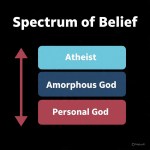
I’m certainly not the only human having wavered between different perspectives and beliefs about God, from the personal to the impersonal, and to the atheistic for some of us—and just as often moving in the opposite direction. I guess that we could refer to this as the “Spectrum of Belief.” In theory (my theory), each one of us is located at a specific position on the spectrum at any given time, which is subject to change, depending upon one’s cumulative and recent experiences. For example, a person may have a strong faith in a personal God, up until a disaster or trauma befalls them, transforming their faith into atheism. It is also quite common for many people to have the same belief from cradle to grave, with no movement on the spectrum.
Christianity versus Judaism:
Growing up, there were only two major religions within my locality, Christianity and Judaism, with Christianity being the most dominant belief system. There was not yet a significant influx of other religions and cultures, such as Hinduism, Buddhism, Islam, etc. So, other than my Jewish heritage, Christianity had an impact on me, but mostly as something I was keenly aware of, not something I practiced or had much knowledge about.
Truth be told, I never adopted any religion as my sole influence or belief system, including Judaism. I believed in the existence of God, but over time, became more interested in alternative ideas that combined both psychology and spirituality.
On a symbolic level, I embrace the Christian cross as a symbol of God continuing to love us and give us second chances to validate being created in God’s image, despite the bad decisions we’ve made with our free will. However, the idea of being forgiven for our sins or bad choices through faith alone, never seemed right to me; nor could I embrace the portrayal of God as an overly lenient parent allowing his child to get away with anything, while continuing to unconditionally love the child—even after metaphorically burning down the house with matches. I’m exaggerating of course, but the implication is that our past and present bad behaviors don’t matter, as long as we demonstrate or develop faith that the son of God, Jesus, died on the cross for our sins.
If faith or belief alone matter, then maybe it is sufficient to live in a cave somewhere, avoiding all earthly interactions and challenges, spending every waking hour validating one’s faith through continuous study, worship, and prayer. Obviously, for the majority of us, this is pretty much impossible nowadays, as we have no choice but to participate in the world and whatever culture or society we reside in.
I’ve been encouraged by several Christian friends to have faith in Jesus, to pray to him for my salvation, and all will be okay at the end of times. That we are now facing the final showdown between good and evil, where good will finally triumph—following an apocalypse— and all the sin and corruption will be healed, and all who kept their faith in God and Jesus will be rewarded—being in close communion with God and his son upon the return of Jesus. As for the faithless ones, would they end up in some version of hell or nonexistence? One friend told me that she was scared for my soul, since I had not embraced Jesus as my savior and the one who died for my sins. Another friend told me that she had enormous difficulty praying for me, as if I already had one foot in hell or nonexistence, because I was not a believer, reader of God’s word, and worshipper. None of this ever had the ring of truth for me.
Please don’t misunderstand, I’m not singling out Christianity. The orthodox Jews of the old country, especially in the shtetls, had schools for continuous study and worship, known as yeshivas. Studying the Torah and Talmud was like a full-time career for the students, being provided with the space of isolation from the concerns and chaos of the outside world, with the exceptions of antisemitism, the pogroms, and the Holocaust, which just about came knocking on everyone’s doors in those days. The yeshivas still exist to some extent but primarily within the communities of the most orthodox Jews, sometimes referred to as Chassidic Jews. As much as possible, they avoid the chaos of the outside world, living in their own relatively isolated bubble, dedicating their lives to Torah study, worship, and prayer.
A significant difference between Christianity and traditional Judaism, is that the older generation of Jews never reconciled the trauma and suffering experienced during the Holocaust with their belief or hope in the existence of a loving, compassionate God who was looking after their best interests. I won’t go into details, but the Holocaust felt like a major betrayal by God for the victims. In fact, at one point, a group of concentration camp captives put God on the stand through a mock trial, jury and all. They wanted to Judge God’s guilt for allowing such injustice and cruelty being done to them, without intervention. It was pretty much a one-sided trial: Guilty unless proven otherwise, which wasn’t going to happen.
On the whole, modern Judaism has become more of a culture, history of persecution, and homeland (Israel) than a religion. It has maintained many of the old religious rituals, as a celebration of Jewish culture, but I’m not so sure where God is in all this, in 2026. The collective memory of the Holocaust and God’s lack of intervention felt like a betrayal of the worst kind, not so different than what I experienced during my breakdown. In fact, many Jews have converted to Christianity or just don’t take religion seriously anymore. And unfortunately, the only thing that hasn’t changed are the stereotypes of Jewish people, which perpetuates antisemitism and the feeling that the Holocaust could happen once again.
The Exodus, miracle at the Red Sea, and Moses returning from Mt. Sinai with God’s commandments, is a great story and maybe the older generation expected another Moses like savior, or proxy of God, to save and rescue them from the concentration camps before millions were slaughtered. But, that never happened.
In hindsight, as I mentioned previously, I don’t know what my family and other Jews thought of God, especially the elders who remained loyal to the Jewish rituals. Was this loyalty motivated by a fear of God? Or was it a validation of one’s heritage, as in staying true to one’s ancestral lineage and upbringing?
I can’t help but think of today’s political environment, with the attitude of “might makes right;” the use of threats and intimidation to keep the order; and the members of a political party supporting the top dog, so to speak, regardless of whether or not their personal, unspoken values align with him/her. Is this much different than Moses climbing down Mount Sinai with God’s 10 commandments, which we are to follow, or else? I can’t answer these questions, because nobody ever told me what they thought of God or if they could even answer these questions, had I asked them. I had a front row seat to watching them play out their rituals and tell their stories, but what was going on behind the curtains, I don’t know. I wish that I could go back in time and ask them about the God they worshipped, what they thought of him, what he meant to them.
The bottom line: Some aspects of both Judaism and Christianity resonate with me, especially the belief that all of us are forgivable. With Christianity, it is through Jesus Christ and having faith in God’s grace. With Judaism, it is the concept of Teshuva, the Jewish belief in repentance, where we take responsibility for our sins or bad behaviors, which includes seeking forgiveness from the people we’ve hurt and/or attempting to repair the damage we caused. The idea of second chances and making good on them, appeals to me, and feels right on a gut level.
But, and this is the BIG BUT, where is God in the grace of forgiveness and our acts of Teshuva? Is God watching and forgiving and redeeming? Is anyone watching or doing these things? If I have any remaining faith, it is that what we do here on earth matters and that we are all worthy of forgiveness and second chances, and someone or something is watching and guiding us in these matters. Or is this more about having a hope for these things?
In my way of thinking and feeling, there is a very thin line between faith and hope. To be honest, I’m not sure there is a difference. The hope for that eternal parent up above, which Carl Jung alluded to in his belief system, is that the desire for God is within all of us, atheists included, and expressed in one form or another. Am I confusing this desire with my hope in the existence of a more personal god? Does this hope still lurk within the depths of my unconscious, despite my damaged sense of faith and lack of religious practice?
Here is an excerpt from the movie, “Rounders,” a conversation between Mike (Matt Damon) and Petrovsky (Martin Landau).
“Petrovsky: “For generations, men of my family have been rabbis in Israel; before that, in Europe. It was to be my calling. I was quite a prodigy, the pride of my yeshiva. The elders said I had a forty-year-old’s understanding of the Midrash by the time I was twelve. But by the time I was thirteen, I knew I could never be a rabbi.”
Mike: “Why not?”
Petrovsky: “Because, for all I understood of the Talmud, I never saw God there.”
Sound familiar? Personally, I never found God in religion, not in a manner that resonated with me.
The Rabbi:
Beginning in my early 30s, I developed a significant interest in my Jewish heritage, wanting to learn what I hadn’t learned during the early years of my Jewish education and experiences. I regretted having missed the opportunity to learn the depth of the Jewish religion and culture. Unfortunately, however, I discovered that a Jewish education for adults was quite expensive, which bothered me a lot, thinking that religious education should never cost money. And so I gave up on any kind of schooled education, pursing whatever I could find online and at book sales regarding the Jewish religion. During this pursuit, I came across the traditional ideas and beliefs of the religion and the books written by Rabbi Harold Kushner, the man who had conducted my Bar Mitzvah in 1976 at age 13, over 50 years ago.
In 1977, a year after my Bar Mitzvah, Rabbi Kushner had a belief altering experience. At the time of my Bar Mitzvah, I suppose that his faith in God was well grounded in the traditions, of God being all powerful and in direct control of everything, sometimes intervening in the world and in our individual lives, and dishing out the rewards and punishments for the choices we make between good and bad. However, in 1977, his 14 year old son died from a rare disease. As a result, his traditional religious ideas were shaken to the core.
I imagine that questions and doubts about his faith were suddenly thrust upon him, including:
How could something so cruel and unjust have happened to my innocent little boy, especially after my life’s devotion to you—God?
How could God allow such suffering in the world, if he is all-powerful and intervening?
This was very close to home for me, not just in distance, but as to my own wavering of belief in God, following my uncle’s sudden death and other painful experiences throughout my life. And I’m certain that some of the friends and family of the victims of “Air India Flight 171” had similar questions and doubts, as does anyone who grieves what seems like terribly unjust events and situations. Where was God in all of this? A question that has reverberated throughout the ages.
Rabbi Kushner could no longer reconcile God as all powerful and infinitely good, with all the suffering in the world. And so he revised his theology, transitioning from an all-powerful God, to a God that is infinitely good and comforting and supportive, but not in control of everything, including human behavior and the laws of nature and the universe that he created. His new theology was articulated in his famous book, “When Bad Things Happen to Good People.” Following its publication, the rabbi became a revered author of many spiritual books, devoted to his son’s memory and revised theology and beliefs.
“God does not cause our misfortunes. Some are caused by bad luck, some are caused by bad people, and some are simply an inevitable consequence of our being human and being mortal, living in a world of inflexible natural laws. The painful things that happen to us are not punishments for our misbehavior, nor are they in any way part of some grand design on God’s part. Because the tragedy is not God’s will, we need not feel hurt or betrayed by God when tragedy strikes. We can turn to Him for help in overcoming it, precisely because we can tell ourselves that God is as outraged by it as we are.”
― Harold S. Kushner, When Bad Things Happen to Good People“Laws of nature do not make exceptions for nice people. A bullet has no conscience; neither does a malignant tumor or an automobile gone out of control. That is why good people get sick and get hurt as much as anyone.”
― Harold S. Kushner, When Bad Things Happen to Good People
Honestly, no disrespect intended, his revised theology at first seemed like a grief ridden adaption to the trauma of losing his son, a way of maintaining his faith in God while explaining God’s lack of intervention in his suffering and the bad hand dealt to his son.
I understand that he needed some way to maintain his faith while making sense of a tragedy he could not explain. What was the alternative? To live in a world and life that is devoid of any semblance of purpose, justice, or someone having a vested interest in our well-being? If that isn’t a recipe for hopelessness, than I don’t know what is.
Arthur Janov, primal psychologist, theorized that the feeling and projection of hope, is a reaction to a deeper, unconscious feeling of hopelessness. One may feel that it’s hopeless to find love, to succeed in life, to survive a chronic disease, to survive at all in a world filled with violence and countless other bad things, but according to Janov, many of us attempt to cover this over with a kind of pseudo-hope. What Janov never mentioned, was the most painful hopelessness of all, to lose or never have faith in the existence of a higher power that protects us, loves us, and/or ensures a just and meaningful universe. This is very painful when we become conscious of this sense of hopelessness.
If there is a hell, it is the feeling that all is hopeless, including oneself, which tortures the most depressed, suicidal, addicted, and violent individuals among us, manifesting in some of the most troublesome behaviors. For the remainder of us, the psyche responds with the opposite, which is hope in something higher, better, meaningful, or loving. Janov referred to it as a necessary survival mechanism. Thus, some of my fondest hopes may be motivated by a deeper sense of hopelessness. Looking back, I believe that Janov’s theory of hopelessness has been true for me to some extent, maybe more than I’m aware of.
I can’t speak for Rabbi Kushner, but as I mentioned, it is possible that his changed theology was his way of reconciling all the bad and unjust in the world, including the death of his son, with a continued hope or faith in God or something of higher intelligence or wisdom. I’m pretty sure that all of us engage in this process to some degree and in some form. I can’t imagine, at age 63, having emotionally survived this long, after all the pain and disappointments I’ve experienced, without maintaining some sense of hope, despite a deep negativity that may lurk underneath it. However, the hope in a God with limitations, whose primary role is to be comforting and supportive following unjust traumas, never worked for me, sounding more like a human therapist than a God. I’ve wanted more from God, regardless of how unrealistic that may be. I hoped for a God who was more like a king, directing my life’s path in some sense, not a therapist.
For a time, I was able to embrace the idea of God being an all-powerful divine force, but having set nature and the universe on autopilot, to ensure that his “WILL BE DONE,” without the necessity of micromanaging every aspect of his creation. Of course, a lot can go wrong when the supervisor is not around to supervise the staff. Tasks get screwed up, rules get broken and exploited, and ethics/morals go down the toilet.
I hadn’t completely written off the idea of occasional interventions by God, when things went seriously wrong in the world and my life, However, my ideas about God became more vague or amorphous with time, the end result of never finding a belief system that completely resonated with me, and noticing the many deficits of godliness in my everyday experiences.
Rabbi Kushner’s solution was to believe in a good God that was here for our comfort and support and strength, explaining away the bad stuff as not of his doing, the result of the natural laws or rules of the universe, or random bad luck. But, according to the Bible and Torah, was it not God who supposedly created the universe and all the laws and rules that go along with it? And what, if any, comfort and support have I ever received from God? If I ever, and I emphasize ever, felt any long-standing compassion from an “other” towards my struggles in this lifetime, I did not attribute it to God. These philosophical/existential issues in my mind, along with my lifetime of personal experiences, beginning on the beach with my dad, were at odds with the rabbi’s revised theology.
I attempted to contact the rabbi several years ago, hoping that he’d kept a copy of the sermon he gave at my Bar Mitzvah so long ago, as it seemed relevant to my life, prior to the changes in his theology. My parents recorded the entire ceremony on tape cassette, but after 40+ years it became too worn down by time to remain audible. And to my dismay, I discovered that the rabbi had passed away a year earlier, buried behind the graves of my parents, along with his son who had inspired his writing. When I visit the graves of my parents, I leave a stone on the graves of the rabbi and his son, a Jewish tradition of honoring and remembering the deceased, as if saying, “I was here.”
I have deep respect for Rabbi Kushner, his spiritual devotion, and his brilliance. I wish that I had arranged to spend some time with him, explaining my issues with belief. Maybe he would have impacted me in some way, bringing more clarity to his beliefs, as books alone are not enough to understand the depths of Judaism. However, I never had the opportunity to speak with him again after my Bar Mitzvah. As always in my life, I often wait too long and miss the boat, so to speak.
Evil and the Devil in religion:
An alternative version of Rabbi Kushner’s God and Not God universe, includes God and an adversary, the Devil, both being engaged in an endless competition for our souls. It is no surprise that so many people believe this, given the potpourri of good and bad in the world; the worst or darkest situations and behaviors being relegated to the category of evil, the domain of Satan and his army of demons. Some would say that God actually created evil and the devil, to test our faith or willingness to do good and obliterate the bad, despite the temptation to do otherwise.
Well, if I believe that gaps exist within God’s universe—vacuums of direct divine power—which he is unable to monitor and manage 24/7, then just maybe, evil forces opposed to God’s rule are able to invade and occupy these gaps or vacuum. Hence, the Devil tempting us to sin or commit evil acts, without the fear of God’s judgment, since he is too busy elsewhere. The serpent in the Garden of Eden tempting Eve to take a bite of the apple, occurred when it appeared that God was not present (or hidden) at the time. The serpent, acted as a proxy to evil inclinations, tempting Adam and Eve to usurp God’s power and utilize his infinite knowledge for their own personal use.
According to the teachings of Judaism, every human being is born with two impulses, the Yetzer Hatov, or good inclination, and Yetzer Hara, or evil inclination. The Yetzer Hara is thought of as the inherent drive for self-preservation, physical pleasure, and ego. The Yetzer Hatov is associated with one’s good conscience to do good things, behave with a sense of morality, and seek a connection with the Divine.
Interestingly, this seems very close to the Freudian concept of Superego (moral conscience) and the ID (unconscious instinctual impulses, such as aggression, sexual fulfillment, physical survival, and genetic propagation). In Freudian psychology, inner conflicts between the superego (Yetzer Hatov) and ID (Yetzer Hara) are what result in the various individual forms of neurosis and psychosis, and the collective chaos happening in the world, including wars, bad politics, genocides, dictatorships, religious fanaticism, victimization of every form, etc. It is too complex of a subject to broach in this post, but as an example, the good inclination often colludes with the bad inclination in a myriad of ways. The appearance of a good person, is sometimes just that, “appearance” used as a means to something darker, or the evil impulse. Modern psychology is primarily concerned with adjusting the ego, which is seated between the Id and Superego, to better manage these inner conflicts for the sake of the individual and world at large.
Christianity differs, in that evil, or Satan, is considered to be a real entity; a fallen angel engaged in an active rebellion towards God, using us as unconscious proxies in the war against God.
So, what do I think about all this? Well, the evil inclination, Yetza Hara, or the existence of a devil entity, still don’t answer many questions. Is the evil inclination or Devil the cause of natural disasters and the bad luck that often befalls us? It seems to be that the evil inclination and Devil are primarily about bringing out the worst of human behavior, and nothing else. What about all the other shit that happens? Should I be content with the saying that, “Shit Happens!”
Psychology and God:
“Your concept of God is often formed by your early experiences with authority figures, such as parents or caregivers.”
– Pathwork lectures, #13
Freud implied that our early unconscious need for a wise, strong, protective father figure, became transfigured into our earliest idea of God or the superego. In most Freudian theory books, the superego represents one’s moral conscience. However, I think it is splitting hairs to separate the superego from the father figure, since the superego is, in a sense, the archetypal parent figure, protector, punisher, rewarder, intervenor, and inner voice of right versus wrong. I replaced father figure with parent figure, as it would be an error to “always” exclude the internalized voice of mother from our earliest concept of God, a relic of patriarchal thinking. It is quite possible that one’s mother had the most influence over a child’s upbringing, or the father was entirely missing or emotionally unavailable to the child, which would may open up a slew of complexities regarding the child’s early God-image: a good god (female) versus a bad god (male). The opposite situation could occur as well: an influential father and missing or emotionally unavailable mother figure.
Did my earliest internalized authority figure—parent/superego—transfigure into an imagined or projected superpower—AKA God—who looked after my well being? Yes, somewhat. I felt protected—maybe even overprotected—and influenced by my father’s concepts of right versus wrong, and this became the first and earliest layer of my God-image: the divine, all-powerful wise king of all, sitting on his throne, watching over me. My mother was very loving and nurturing, but seemed to be guided by my father as well; I felt guided by him and intimidated at the same time, as he seemed in control over my survival and my access to nurturing—my mother at the time.
I don’t remember what I thought about the bad stuff going on in the world or the abuse happening to me (being bullied at school), other than trying to get away from it. And I don’t recall splitting the divine into a good God and bad God (or no god), or having any concept of evil at that young age. I filled in my God-image with various details and additional layers, taken from my limited exposure to the Jewish religion, my dad’s explanation of God during our walk on the beach, and Cecil B. DeMille’s portrayal of God and Moses, in the movie, “The Ten Commandments.”
My early God-image persisted in the background until I left home for marriage, followed by the traumatic event of my uncle’s sudden death, which shattered any feeling of being watched over, loved, and directed by a higher power. Suffice to say, I felt betrayed or abandoned by my faith in God’s existence, driven out into a world of events and forces indifferent to my well being. Metaphorically, I was driven out of the Garden of Eden, but why? A punishment for leaving home to declare my independence? Indulging in a lifestyle that neither a mother or father would approve of?
Truth be told, I did not consider such things following my uncle’s death. I was overwhelmed to the point of having a breakdown for several weeks, and when I reached out for help, none was available to me, reinforcing the sense of fear I was feeling, that nobody cared, not even God, if he even existed. It was like being left for dead on the side of the road, bleeding profusely. I came to the traumatic conclusion that nobody was looking after me or directing my path. I was on my own, my survival and existence within my own hands. And so that was my breakup with my first God-image.
Gradually, over the years, I redeveloped an interest in a higher power or intelligence, but from a theoretical or conceptual perspective, rather than it being feeling based. I participated in a couple of groups that were like think tank discussions and debates about the purpose of being human and the existence of God. The discussions went on for a few years, until I exited the groups, as they seemed to be going in circles, never arriving anywhere. However, I walked away with the belief in the existence of a higher, intelligent power, as I cannot logically believe in a random, purposeless universe. Yet, as I said, I don’t feel this belief, rather I only think it to be so. Returning to my spectrum of belief diagram, I’m now somewhere in the middle, believing in an amorphous, higher presence, without a particular form or location, nor any personal interest in my well being.
“I cannot prove to you that God exists, but my work has proved empirically that the pattern of God exists in every man and that this pattern in the individual has at its disposal the greatest transforming energies of which life is capable. Find this pattern in your own individual self and life is transformed.”
~ C. G. Jung
Despite my conceptually based belief in a higher power, I’ve continued to be emotionally moved by scenes of intense Christian faith and the symbolic cross; the depiction of Moses climbing Mount Sinai to meet God; and my own writing, which sometimes dribbles or floods my writing with divine sentiments, such as my poem in “Her Smile.”
Why is this? Maybe what’s left of my Freudian superego continues to influence me on an emotional level, still searching for dad within my current God-image? Or maybe I’m being affected by an inherent, human desire for a personal God who is all powerful and invested in our well being? Jung believed that the pattern of God exists within every individual, including the atheists among us. As an example, there is a growing group of rational, scientific oriented atheists who believe that one day, AI will attain a level of wisdom that surpasses human beings, even becoming a conscious, purposeful entity. Seems to me that they are seeking a god through rational, scientific ingenuity, while keeping to their belief that a god didn’t create the universe and never existed.
If I’m to conclude anything, it is that everyone has the desire for something bigger, wiser, kinder and more just than themselves, including the atheists and megalomaniacs among us. This desire for God always exists within us, even if not recognized as such. The difficulty arises when we try to form an image of a god or gods with specific attributes that don’t match up with our earthly experiences, where God’s presence was expected, but seemingly nonexistent.
In one way or another, all of us try to explain our existence either with or without a god or gods, and within the personal contexts of our lives. But more often than not, if we live long enough, something happens or comes along to contradict what we’d previously settled on as our explanation, and we either revise our explanation, find a new religion, fall into despair, or decide that we just don’t know what is going on and why. It seems that I fall into that last category with my amorphous God, as do many others who claim to believe in God, but don’t hold any particular belief or God-image within their view of the world and their specific existence. The truth is that I just don’t know what is going or what exists beyond what I can perceive and experience, and no amount of analysis or intellectualizing will bring me any closer to “knowing.”
Crisis:
In March 2025, I was hospitalized by my doctor, after she discovered that something bad was going on with my body. I’d already suspected something wasn’t right, but I’d never imagined being sent to the hospital with an urgency. I won’t go into details, but the doctors diagnosed me with a serious, irreversible health condition, which could potentially threaten my life some day. Since then, I’ve improved my health around this condition, but yet the condition is still there, lurking, like a predator in waiting. And so there is no such thing as certainty for me anymore, not that there ever was.
However unlike the trauma, breakdown, and loss of faith I experienced 36 years earlier following my uncle’s sudden death, I didn’t feel traumatized this time, nor did I question the existence of God.
Long ago, I lost my belief in a personal God who is protective, intervening, and answers prayers. Yet, my amorphous god has remained constant, despite the ever-present threat of death—not just mine, but for anyone who notices the apparently random, indifferent nature of the universe. It is a universe that creates and destroys with no regard for our feelings, as seen in the tragedy of “Air India Flight 171,” or any life-ending incident that feels like the mere bad luck of the draw or part of a higher, incomprehensible agenda.
Intellectually speaking, where I now find myself is somewhere between belief and disbelief, like a nomad wandering through the desert, searching for a sign pointing to something more to this life, a meaning or purpose within my life’s circumstances. This is not a very comforting place to exist on the spectrum of beliefs. Thus far, I’m left to creating theories about God.
The following is an up-to-date summation of what I consider to be possible explanations that support the existence of God or a higher intelligence.
Summation of possible explanations, supporting God’s existence:
1) A universe set to run on autopilot, per the order or design of God, which often leaves us caught in its gears of operation, like an insect stumbling into a spider’s web.
2) God not yet being omnipresent enough to manage and watch over the entire universe, including the worlds and creatures of his creation. The bigger and more complex the creation, the more difficult it is to manage. The chaos throughout the world is a testament to this possible reality. Maybe God has temporarily solved this problem by setting the universe on autopilot, as described in explanation #1 above.
3) A “work in progress” God who doesn’t have his creation all figured out yet, like a kid with his Legos, always building things and then knocking them down to start over, until he/she gets it right. This harkens back to the story of Noah’s Ark, where God destroyed most of humanity, to start over again, since version one went off the rails, creating more evil than good in the world. In fact, many people believe that the various natural disasters, wars, and violence in the world are steadily increasing, and will eventually end in an apocalypse, when God finally decides to knock down the metaphorical Legos, and start over once again.
4) God recruited or created spirits to watch over and manage the still vacant spaces within his creation. However, they evolved their own agenda, spewing evil and chaos in the world, in an attempt to undermine God and usurp his powers and influence. Sounds like a familiar situation in today’s world, except that we no longer blame it on a devil, instead deferring the explanations to science, psychology, and politics.
Note: When God was apparently busy elsewhere in the Garden, Adam and Eve took bites of the forbidden fruit, for the purpose of acquiring God’s full range of powers and knowledge. The serpent, who encouraged Adam and Eve to indulge in the fruit, was “maybe” the early incarnation of the devil (as the story goes).
5) God having created evil and disasters to test our faith in him.
6) Neale Donald Walsch, author of the Conversation with God series, claims that we first need to experience what we are NOT—evil Sinners—before we can discover, know, and embrace our true essence of goodness—God. On the surface, this seems to explain why God’s existence seems missing or hidden within all the bad in the world, maybe even temporarily hidden within each individual. However, just like Rabbi Kushner’s theology, it seems more like an attempted reconciliation of faith in God with an uncaring or evil world.
The more orthodox or Hasidic forms of Judaism have a somewhat similar idea, which is that there are divine sparks all over, often hidden within the darkest aspects of our human nature, waiting to be released by us. The more sparks we release, the more we are healed and embrace God’s image. I’ve not yet seen any indication that the world works this way.
7) A universe run by karma that both punishes and rewards us, based upon our individual and collective actions of the past. Instead of an indifferent universe being on autopilot, tragic events, such as an air disaster, may be the result of a collective balancing or punishment assigned to a specific group of people who set this karma in motion. Again, this seems to be a way of reconciling the good with the bad in the world and within individual lives. Yet, this theory seems beyond examination, as we have no way of recalling past events or behaviors beyond a certain point in time. Believers have no choice but to accept the notion that their current circumstances are the result of a past that they cannot recall.
Regression experts attempt to restore the memories of a client’s past lifetime(s), but there is no proof that actual memories are being restored, rather than the mind creating stories.
8) Jung proposes that regardless of whether or not God exists, the pattern and desire for God is within all of us, consciously or otherwise. Many people, including so called atheists, don’t realize that they are seeking God or a god, labeling it as something else. Artificial intelligence is a perfect example of this, as scientists and software engineers attempt to build an all-knowing, decision making intelligence that is superior to human beings in every way.
A much as I dig Jungian ideas, the “desire for God” theory explains more about human psychology than anything related to the actual existence of God.
9) The continued influence of the internalized voices—superego—of Mom and Dad, are still keeping alive my childhood image of God: the one who intervenes and protects me, always guiding me as to the difference between good and bad, and making things right when they go wrong. My parents are long gone, but maybe I’m still seeking their comforting qualities through a God?
Jung’s theory of an inherent desire for God and Freud’s parental superego, superimposed onto a God-image, seems closest to home on an emotional level. This may in fact explain why I continue to be moved by such things as the Christian cross, Christian music, depictions of great faith, beautiful sunsets that trigger feelings of being close to God, a smile that feels like a God’s compassion and love shining upon me, a movie with Charlton Heston, etc.
Note: I’ve spent much of my life seeking God through the unconditional love from others. Although, I’ve expected too much from people in this regard, resulting in many painful experiences.
Bottom lines:
Intellectually, I cannot go beyond my amorphous God, but emotionally I crave the personal God. I cannot connect my intellectual and emotional sides in this regard. And truth be told, except for the Jungian and Freudian explanations, everything else I listed in my summation of possible explanations, is pure intellectual play, where my mind is left to come up with theories for something that is incomprehensible and ultimately unprovable.
The mind is always attempting to explain things it will never comprehend or find any proof for. In a sense, this is how our beliefs come about, including my own. I’m not any different than Rabbi Kushner in this respect, as my intellectual theories are my attempt to reconcile the dark side of human nature and apparent indifference of the universe, with the existence of a personal, loving God.
I’ll turn it around a bit, and suggest that “maybe” it is the task of human beings to embrace what we hope are God’s attributes, and reject and fight against their opposites (evil and indifference), as much as humanly possible. This is what works best for me. If the love, protection, and intervention of a personal god is not available to me and others, then I will try my best to mimic those qualities in the world, albeit within my personal and human limitations. The best that I can do for now, is act as though I’ve been created in God’s image, when possible for me.
There is a saying that “The Devil is in the details.” How about “God being in the details,” within the small, positive things we do here, and within those breathtaking moments that seem to arise spontaneously, like my poem in “Her Smile.”
We live a harsh existence, and there is no escaping that, regardless of whether or not a higher intelligence or God set it up that way. However, the possibility of experiencing love—the giving and receiving of it—or extraordinarily special moments, is what sustains many of us, myself included. I think this is where I look for God at my age. All other possibilities, including the ones I listed above, no longer carry much psychological weight for me, even if there is truth to one or more of them.
The intellectual side of myself will always believe in a higher wisdom or divine presence behind the creation and continued evolution of the universe; my amorphous god. But, in my heart of hearts, I sometimes feel God’s presence right here on earth, sometimes coming through others, sometimes from within myself towards others, and sometimes through experiences of extraordinary beauty.
I’ve experienced special moments throughout my life: a beautiful sunset, the roar of waves and sight of sunlit sparkles on the ocean, a song sung with soulful passion, the way someone smiles at me or loves me, depictions of others committing selfless acts of kindness and faith, and many other moments. Yep, all of this is how I experience God on an emotional level, rather than solely through the intellectual search that never provides proof of anything.
So, that’s it, folks! If you’ve managed to maintain your interest while reading this long-winded post, maybe you expected that I would provide a coherent argument or theory for the existence or nonexistence of God. I cannot, though. My intellectual play gets me nowhere, beyond giving the impression of being smart or an adequate philosopher.
Personally, for me, God is more of a feeling and hope, rather than a specific belief or theory. I was not conscious of how I actually thought or felt about God, until writing this post. This was my first time pondering God to this extent. And just like the rabbi, I’ve needed to reconcile a life full of pain, fear, bad luck, indifference and confusion with the possibility of God being present in some form. And so this is what I’ve come up with: a God that shows his love through the special moments of life, even if they don’t last or change the course of my circumstance.
The irony being that I’ve arrived at the same place as Rabbi Kushner, believing that God enters our human lives at various times, but as a passionate and compassionate occurrence, not as someone or something that changes or fixes our circumstances. What a crazy situation, to discover that the man I disagreed with, I now find myself being in sync with.
“We can have in life but one great experience at best, and the secret of life is to reproduce that experience as often as possible.”
– Oscar Wilde
End notes #1: I’m not a bible scholar, Torah student, or expert regarding Christianity and Judaism. I know enough to include it in my ramblings and writing works, but it is possible that I’ve made some errors of misinterpretation here. Also, there was no intention to discount or put down any of the religious beliefs mentioned here, including Rabbi Kushner’s revised theology. I’ve included these topics as they’ve had a profound influence on me over the years.
End notes #2: I’ve referred to God as a he or him, just for convenience sake and not because of a patriarchal attitude, which I don’t have. Referring to God as a “she,” “it” or “they” may have led to some reader confusion, or even my own confusion. My concept of God is gender neutral, but the limitations of language often adds a layer of complexity to whatever it is I’m trying to say. I’m aware that some religions have multiple gods, both male and female.
© 2026 David M. Rubin. All rights reserved.
 Notes from David